
Table of Contents
Title: Handmade Jutti Techniques: 9 Rare Secrets of This Beautiful Craft
Meta Description: Unlock the hidden artistry behind handmade jutti techniques. Discover 9 rare secrets of this traditional footwear, from hidden stitches to ancient tool use, that define true handcrafted leather mastery.
(Image 1: A high-contrast, moody photograph of a master artisan’s weathered hands holding a traditional, curved ari awl and a needle, poised over a piece of supple leather. Alt Text: The foundation of all handmade jutti techniques lies in the artisan’s skilled hands and specialized tools.)
Introduction: The Unseen Art Beneath Your Feet
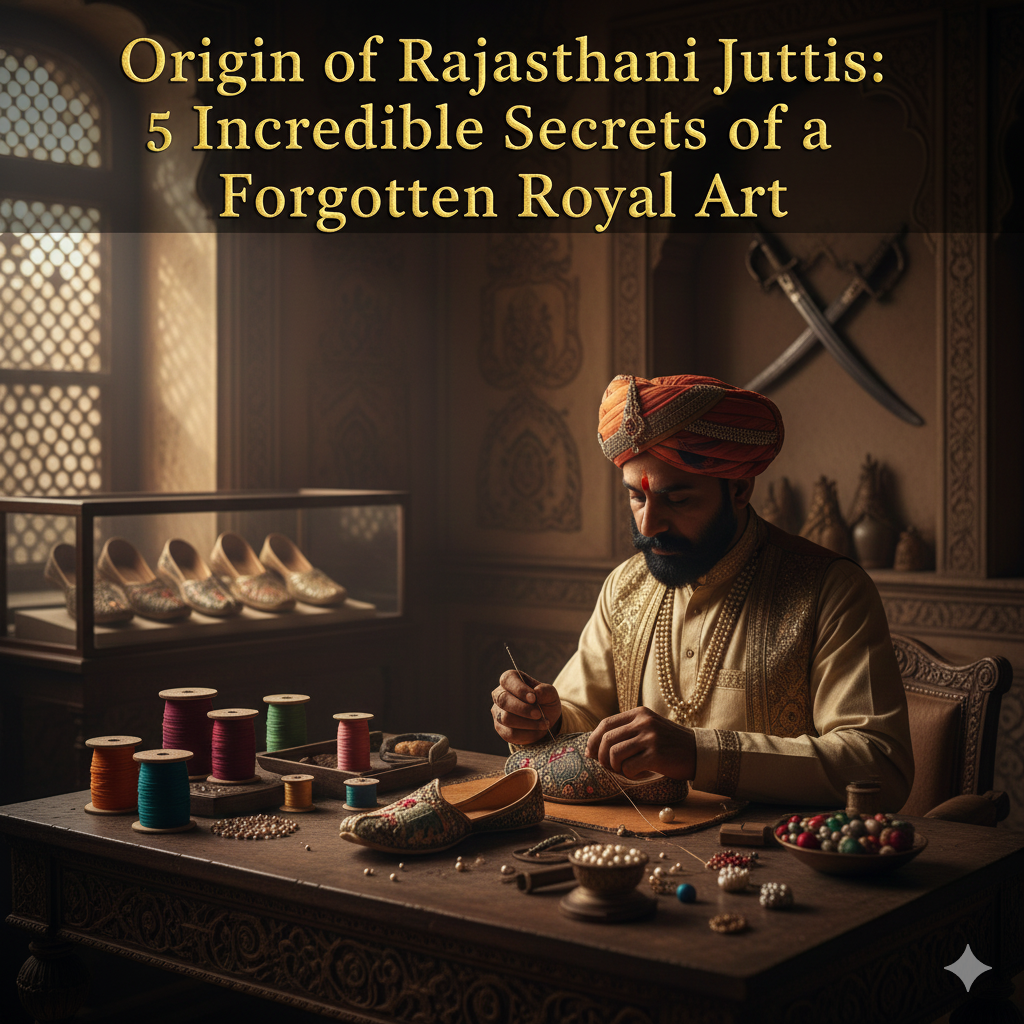
In a world dominated by the hum of machines and the uniformity of assembly lines, a quieter, more profound art form persists in the narrow lanes of Punjab and Rajasthan. This is the world of the handmade jutti. While the final product—a vibrant, intricately adorned piece of traditional footwear—is celebrated, the true magic remains largely unseen.
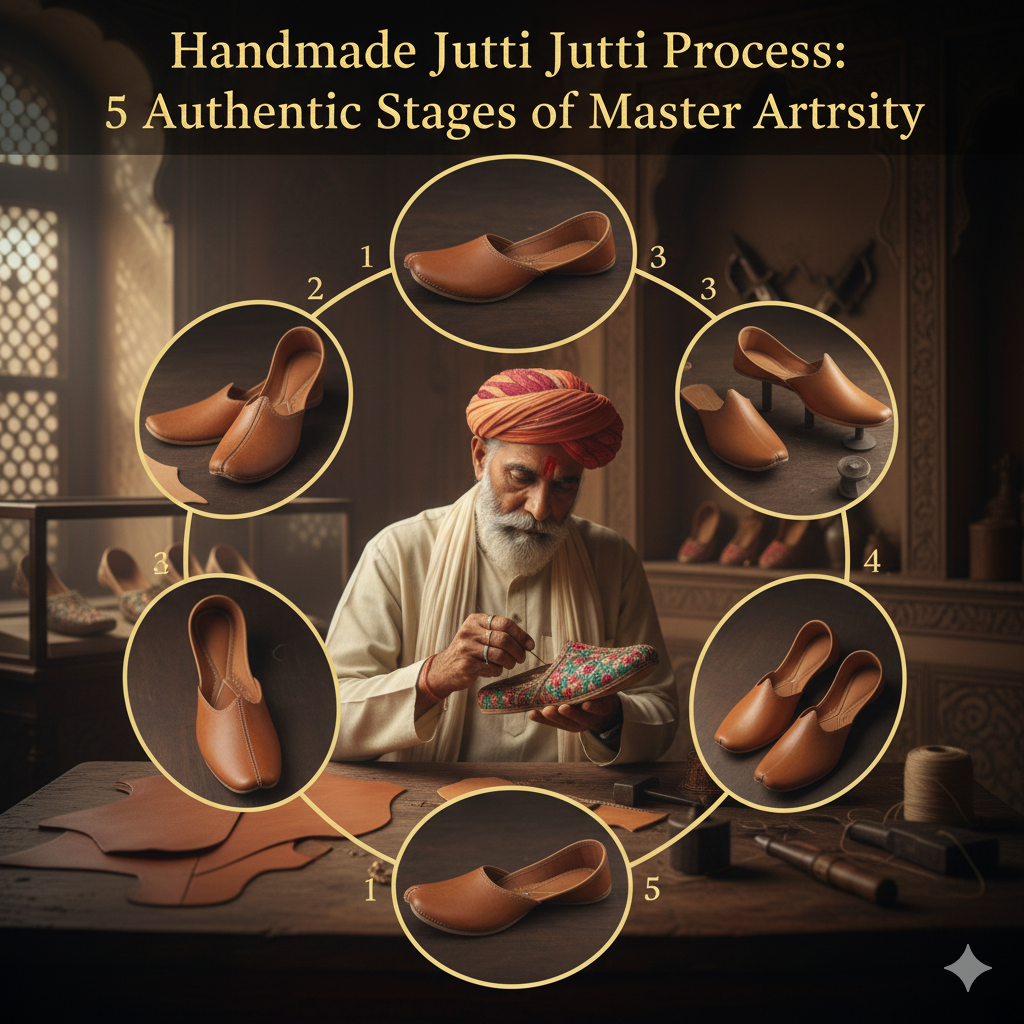
The real story is etched in the handmade jutti techniques themselves, a complex language of skill passed down through generations. These are not mere steps in a process; they are guarded secrets, refined over centuries, that transform raw handcrafted leather into wearable heritage. This blog pulls back the curtain. We reveal nine rare secrets of this beautiful craft, offering a deep appreciation for the precision, patience, and profound knowledge embedded in every single pair.
Secret #1: The Sacred Selection & Preparation of Leather
The first, often overlooked secret begins long before a needle touches hide. Superior handmade jutti techniques are wholly dependent on the sacred selection of leather. Artisans are not just choosing a material; they are selecting a partner in creation. Goat skin is prized for the uppers due to its soft, pliable grain and ability to hold fine embroidery without tearing. Buffalo or cow leather forms the resilient, multi-layered sole.
The secret lies in the preparation. The chosen hide is not simply cut. It is carefully inspected for grain consistency and thickness. It is then “cured” or tanned using natural methods, often with vegetable tannins, which make it supple and breathable—a hallmark of quality handcrafted leather. This meticulous selection is the non-negotiable foundation. A flaw here cannot be corrected later, making this the first and most critical secret in the artisan’s repertoire.
Secret #2: The Ari & Sui – Tools That Are Extensions of the Hand
The artisan’s primary tools are themselves a secret to the craft’s integrity. Unlike power tools, these instruments require and amplify human skill. The Ari is a unique, curved awl with a razor-sharp tip. Its curvature is not accidental; it is designed for the specific angle required to pierce through multiple layers of handcrafted leather and create the perfect guide hole for stitching without tearing the material.
The Sui is the heavy-duty needle, often hand-forged, that follows the Ari‘s path. The secret technique involves a specific wrist motion—a fluid roll—that allows the ari to enter and exit the leather at the precise depth and angle. This manual piercing creates a clean channel for the mochi ka dhaaga (the cobbler’s specially waxed thread), ensuring every stitch is strong, even, and part of the traditional footwear‘s enduring structure. The tools are simple, but their mastery is a lifetime’s work.
(Image 2: A detailed flatlay of traditional jutti-making tools: the curved ari awl, several sui needles of different sizes, a leather knife (rampi), a hammer, spools of thick waxed thread, and a wooden last. Alt Text: Specialized tools like the curved ari are central to authentic handmade jutti techniques for traditional footwear.)
Secret #3: The Invisible Mochi Stitch – Strength From the Inside
While embroidery dazzles the eye, the true strength of traditional footwear lies in a hidden stitch. The Mochi stitch or tanki is a masterpiece of structural engineering performed from the inside of the shoe. After the embroidered upper is stretched perfectly over the wooden last, the artisan works from within. Using the ari and sui, they stitch the upper to the insole using a backstitch technique with incredibly strong, waxed thread.
The secret is that this stitch remains completely invisible on the exterior sole. It creates a bond that is flexible yet immensely durable, allowing the shoe to flex with the foot without the threads snapping. This is the technique that prevents soles from detaching—a common failure point in machine-made shoes. This invisible, internal lock is a defining secret of genuine handmade jutti techniques, guaranteeing longevity that mass-produced footwear can never achieve.
Secret #4: The Phulkari of the Sole – Embroidery’s Hidden Discipline

When we think of embroidery on juttis, we picture the vibrant upper. But a rare secret lies beneath the foot: the embroidery of the insole, known poetically as the Phulkari of the Sole. Before the sole is attached, the soft leather insole is often adorned with a simple running stitch or a delicate pattern. This serves a dual purpose. Firstly, it is a mark of completeness, a signature of an artisan who cares for details unseen.
Secondly, and more practically, the raised texture of the stitching provides a gentle grip for the foot, preventing slippage inside the shoe. This hidden artistry, a gift known only to the wearer, exemplifies the holistic philosophy of handmade jutti techniques. It signifies that every element, seen or unseen, is crafted with intention and care, elevating the handcrafted leather from mere commodity to a personal, thoughtful object.
Secret #5: The Language of Motifs – A Stitched Vocabulary
The motifs are not random decorations; they are a formal, stitched vocabulary. Each pattern in traditional footwear carries specific meaning and origin, a secret language understood by connoisseurs. The Boota, a small floral or paisley motif, symbolizes growth and fertility. The Jaal (net or lattice) represents interconnectedness and artistry. The Chand (moon) and Taare (stars) are motifs of divine blessing and guidance.
The technique of embedding Shisha (tiny mirrors) is not just for sparkle; it is rooted in the ancient belief of warding off the evil eye. An artisan doesn’t just “draw” these; they narrate them with thread. Knowing which motif to use where, and how to balance a composition on the curved, uneven canvas of a shoe upper, is a secret design intelligence integral to advanced handmade jutti techniques. It transforms embroidery from ornamentation to storytelling.
(Image 3: A close-up, top-down view of a jutti upper mid-embroidery. The image highlights several distinct motifs: a central floral (phool), a paisley (boota), and the beginnings of a lattice (jaal), with tools nearby. Alt Text: The language of motifs is a key secret in handmade jutti techniques, where each stitch in traditional footwear tells a story.)
Secret #6: The Alchemy of Natural Dyes & Color Fixation
Long before chemical dyes, artisans were alchemists of color. A rare and fading secret involves the use of natural dyes extracted from plants, minerals, and insects to color the handcrafted leather and threads. Pomegranate rind and myrobalan fruit yielded yellows and tans. Indigo gave deep blues. Lac insects provided a vibrant red. The secret technique was in the “fixing” or gado process.
The dyed material would be treated with natural mordants like alum or iron salts, and sometimes even soaked in tamarind seed paste, to bond the color to the leather fibers, making it sun-fast and long-lasting. This process resulted in rich, earthy, complex hues that aged gracefully. While largely replaced today, knowledge of this alchemy represents a deep, ecological wisdom within the handmade jutti techniques, connecting the craft directly to the natural world.
Secret #7: The Wooden Last – The Silent Sculptor
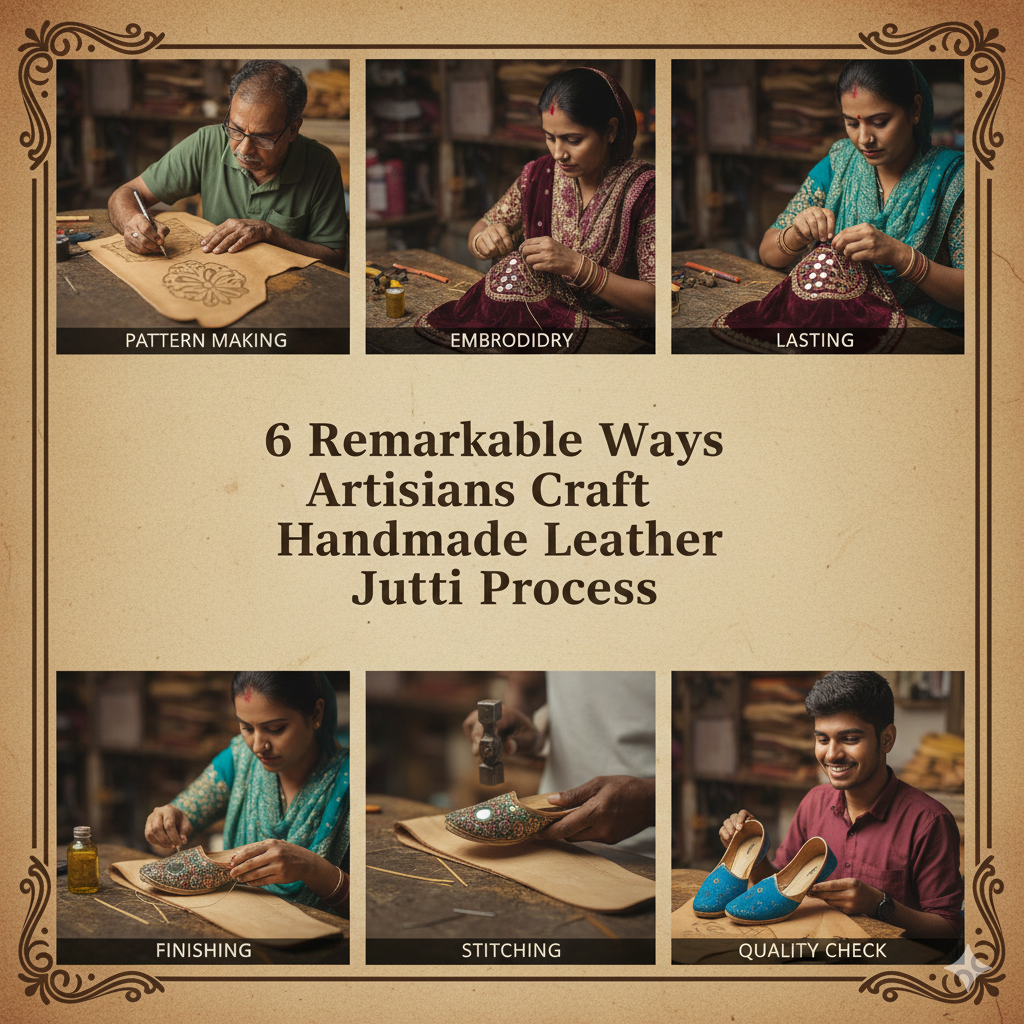
The humble wooden last is the silent, unchanging sculptor of every jutti’s form. This is not a generic shoe mold. Traditionally, a last was custom-carved for a specific client or family, capturing the unique contours of their feet. The secret technique lies in the “lasting” process. The flat, embroidered leather upper is dampened slightly to make it pliable. It is then stretched, pulled, and tacked over this three-dimensional wooden form with immense precision.
The artisan must apply even tension in all directions to avoid wrinkles and ensure the embroidery sits perfectly on the final curve of the foot. This transformative step—turning a 2D artwork into a 3D form—is where the shoe truly takes shape. The traditional footwear‘s comfort and elegant silhouette are born in this intimate dialogue between supple handcrafted leather and unyielding wood.
Secret #8: The Layered Sole – Engineering for Endurance
The sole of a jutti is a masterpiece of layered engineering, a secret to its legendary durability. It is never a single slab of leather. True handmade jutti techniques involve building up the sole from multiple layers. Typically, three to five layers of thick buffalo leather are glued and stitched together. Each layer is cut slightly differently: the innermost layer is the largest, providing a platform, while subsequent layers are smaller, creating a built-up, rounded edge that is both flexible and protective.
The stitching that binds these layers is often the robust bakhiya stitch, done with a double needle, creating a parallel line of stitching that is incredibly resistant to wear. This composite construction absorbs shock, provides insulation from hot or cold ground, and can be re-soled when the bottom layer wears out, extending the life of the traditional footwear for decades.
(Image 4: A cross-section or exploded-view illustration showing the layers of a jutti sole: insole, mid-layers, and outer sole, with stitching holding them together. Beside it, a photo of an artisan hammering layers together. Alt Text: The layered sole construction is a crucial secret in handmade jutti techniques, ensuring the durability of handcrafted leather traditional footwear.)
Secret #9: The Gota & Kinari Application – Precision Without Margin
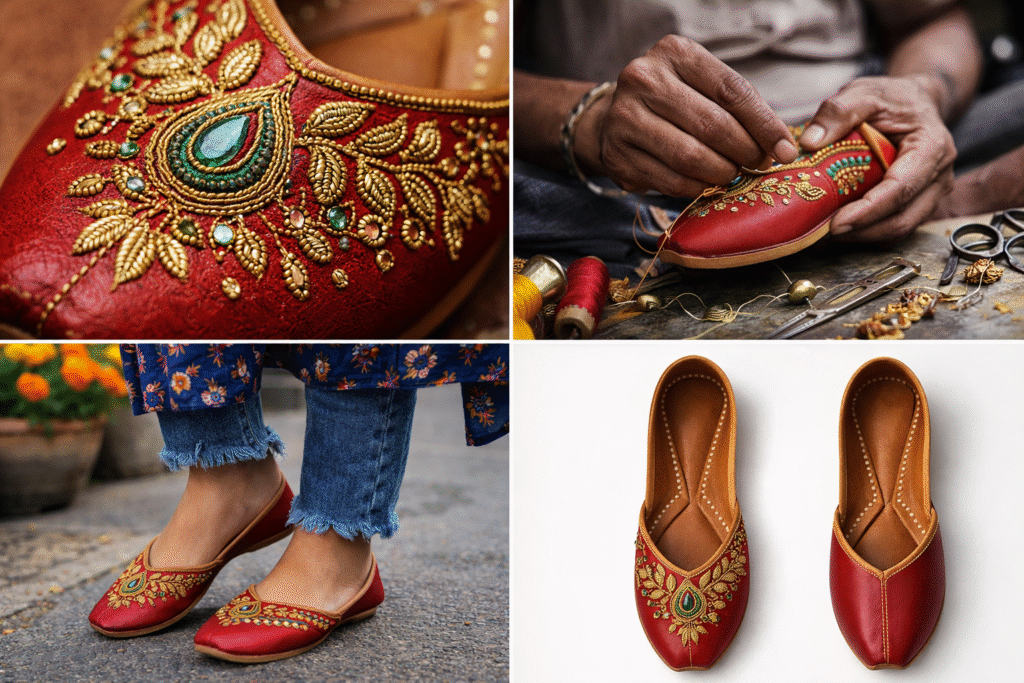
The application of Gota (metallic ribbon) and Kinari (lace) is a test of ultimate precision and patience, often performed by women specialists. The secret technique involves not sewing through the center of the thin, fragile metallic ribbon, which would cause it to pucker and tear. Instead, the artisan uses an almost invisible straight stitch or a catch stitch along the very edge of the gota, securing it flatly to the leather. For complex patterns, the gota is often folded and shaped into leaves, petals, and geometric forms entirely by hand before being attached.
This requires an intuitive understanding of geometry and an incredibly steady hand. There is no room for error; a single misplaced stitch can distort the entire pattern. This minute, painstaking work is what gives regal juttis their characteristic shimmer and is one of the most delicate and respected handmade jutti techniques, showcasing a pinnacle of handcrafted leather adornment.
The Modern Evolution: Preserving Secrets in a Machine Age
These nine secrets now exist in a tense, beautiful dialogue with the modern world. The core handmade jutti techniques remain unchanged, but their context has evolved. Electric lights now illuminate workstations, and pre-dyed threads are common. The true challenge and adaptation lie in preservation. Some cooperatives are digitally documenting stitch patterns and motifs.
Master artisans conduct workshops to pass skills to a new generation. The market itself, with a growing demand for authentic, sustainable goods, is becoming a powerful patron of these secrets. The modern evolution isn’t about replacing the secrets but about creating ecosystems—through fair trade, storytelling, and education—that allow this rare, beautiful craft to breathe and thrive in the 21st century, ensuring these handmade jutti techniques continue to define traditional footwear for generations to come.
(Image 5: A hopeful, well-lit image of a young apprentice watching closely as a master artisan demonstrates a stitching technique on a jutti. It symbolizes the passing of knowledge. Alt Text: Preserving the rare secrets of handmade jutti techniques ensures the future of this handcrafted leather traditional footwear.)
Conclusion: More Than a Shoe, A Legacy in Every Stitch
To understand handmade jutti techniques is to understand a philosophy. It is a worldview where time is an ingredient, where the human hand is the ultimate technology, and where beauty is built from the inside out. These nine rare secrets—from the sacred leather and the curved ari to the invisible stitch and the layered sole—reveal that a jutti is not assembled; it is grown through skill.
Each pair of this traditional footwear is a capsule of knowledge, a testament to the belief that some things cannot be rushed or replicated by machines. When you choose authentic handcrafted leather juttis made with these techniques, you are not just buying a product. You are safeguarding a legacy. You are wearing a story of precision, patience, and cultural intelligence. You become part of the chain that keeps these beautiful secrets alive, one perfect, intentional stitch at a time.